

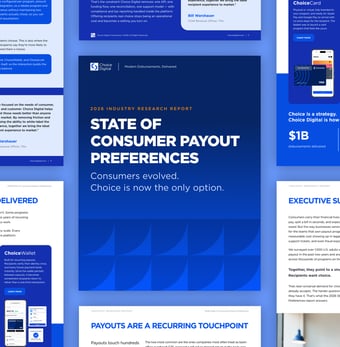
2026 Industry Research Report
2026 State of Consumer Payout Preferences 94% of recipients want choice in how they get paid. Are you giving it to them?
We surveyed 1,567 U.S. adults who received a business payout in the past two years and analyzed redemption behavior across thousands of programs on the Choice Digital platform. Every finding is on this page. Read it free, or get the designed PDF to save and share.
By Choice Digital · 1,567 respondents + platform data from thousands of programs · Updated
What are the key findings of the 2026 State of Consumer Payout Preferences report?
The short answer
Recipients want choice. In Choice Digital's 2026 survey of 1,567 U.S. adults, 94% said choice of payout method is important when receiving funds, and 79% said it matters a lot. Prepaid card options are the top preference (47%), ahead of PayPal or Venmo (30%) and paper checks (23%). Choice pays off for brands: 82% would be satisfied with a company that lets them choose, 74% are more likely to engage again, and 68% are more likely to join a promotion or rebate. Checks fall short: 57% would be dissatisfied receiving one in the mail, and 47% say a two-week delay would cause financial strain.
Consumers carry their financial lives on their phones. They tap to pay, split a bill in seconds, and expect money the moment it's owed. But the way businesses send money hasn't kept up. For the teams that own payout programs, that gap has become a measurable cost, showing up in lagging engagement rates, support tickets, and fraud exposure.
That near-universal demand for choice is the part the industry already accepts. The harder question is what recipients do once they have it. This report answers it with two sources: what recipients say (the survey) and what they actually do (redemption data from the Choice Digital platform).
- 94%say choice of payout method is important when receiving funds
- 82%would be satisfied with a company that lets them choose how to get paid
- 74%are more likely to engage again with a company that offers payout choice
- 68%are more likely to participate in a promotion or rebate when they can choose
- 47%prefer a prepaid card option: physical or virtual prepaid, digital card, or push-to-card
- 88%rate a no-fee experience very or extremely important
- 57%would be dissatisfied receiving a check in the mail instead of digitally
- 47%say a two-week delay in receiving money would cause financial strain
- 38%say their most recent payout was not the method they would have chosen
Source: Choice Digital, 2026 State of Consumer Payout Preferences. Survey of 1,567 U.S. adults.
What is the main finding of the 2026 consumer payout research?
The main finding is that recipients want choice in how they get paid. 94% of U.S. adults say choice of payout method is important when receiving funds from a business, according to Choice Digital's 2026 State of Consumer Payout Preferences report.
What does the 2026 State of Consumer Payout Preferences report cover?
The report covers how often consumers receive business payouts, what they value most when they get paid, which payout methods they choose at different amounts and menus, how payout choice affects brand perception, the costs of paper checks, and a four-step playbook for building a payout program recipients prefer.
How often do consumers receive payouts from businesses?
Often. 80% of recipients get business payouts more than a few times a year, and 40% get one monthly or more often. Payouts touch hundreds of millions of Americans every year through refunds, claims, reimbursements, deposits, rebates, incentives, settlements, and relief payments.
- 80%of recipients get payments more than a few times a year
- 40%of recipients get a payment monthly or more often
- 62%received a refund or deposit return in the past year
- 61%received an incentive or reward payout in the past year
Which types of business payouts do consumers receive?
Share of recipients who received each payout type in the past year.
| Payout type | Received in past year | Bar |
|---|---|---|
| Refund or deposit return | 62% | |
| Incentive or reward payout | 61% | |
| Claim or reimbursement | 37% | |
| Marketplace or platform payout | 22% |
The two most common payouts are the ones companies most often treat as back-office overhead. But if a recipient engages with your payout process several times a year, the transaction becomes a relationship. Every payment either reinforces the impression that you're easy to deal with or chips away at it.
“The research tells us how much choice matters to people. Our platform shows what actually happens when they finally get it, and that's the part no one else can see.”
What is the most common type of business payout?
Refunds and deposit returns are the most common: 62% of U.S. adults received one in the past year. Incentive and reward payouts are close behind at 61%, followed by claims or reimbursements (37%) and marketplace or platform payouts (22%).
Why are payouts a customer experience touchpoint?
Because they repeat. 80% of recipients get business payouts more than a few times a year and 40% get one monthly or more. A payout that happens that often stops being a one-off transaction and becomes part of the customer relationship.
What matters most to consumers when they receive a payout?
A no-fee experience (88%) and fraud protection (85%) top the list, followed closely by choice of method (79%). No fees and fraud protection are the price of entry. Choice and speed are what turn an adequate payout into one people actively prefer.
| Factor | Very or extremely important | Bar |
|---|---|---|
| No-fee experience | 88% | |
| Fraud protection | 85% | |
| Choice of payout method | 79% | |
| Customer support access | 75% | |
| Speed of delivery | 72% | |
| Instant usability of funds | 70% |
Today's payout expectations are clear. Consumers expect to receive their money without friction, without fees, and with the flexibility to choose how they get paid. Just as important, they want confidence that support is available if something goes wrong.
How important is choice of payout method to consumers?
Very important. 94% of recipients say choice of payout method is important when receiving funds, and 79% rate it very or extremely important, ranking it third behind a no-fee experience and fraud protection.
Do consumers care about fees on payouts?
Yes, more than anything else. 88% of recipients rate a no-fee payout experience very or extremely important, making it the top factor in the 2026 survey. Unexpected fees are also the top trust-killer, named by 70% of recipients.
How important is fraud protection when receiving a payout?
85% of recipients rate fraud protection very or extremely important when receiving a payout, second only to a no-fee experience. 51% say fraud or security concerns hurt their trust in a payout.
How important is payout speed to consumers?
72% of recipients rate speed of delivery very or extremely important, and 70% say the same about being able to use funds instantly. 58% say today's economy makes receiving money quickly more important.
How do consumers prefer to get paid in 2026?
When asked to rank their top payout choices, consumers put prepaid card options first. 47% prefer a physical or virtual prepaid card, digital card, or push-to-card payout. 30% prefer PayPal or Venmo, and 23% prefer a paper check.
Source: Choice Digital, 2026 State of Consumer Payout Preferences survey (n = 1,567).
Stated preference is only half the picture. Platform data shows that redemption behavior shifts in two ways: with the size of the payout, and with the menu of options offered. Two views of the data make that clear.
Same menu, four payout sizes: digital vs. physical prepaid cards
Share of disbursements by selected method, for programs offering only digital and physical prepaid cards.
| Payout amount | Digital prepaid card | Physical prepaid card |
|---|---|---|
| Under $50 | 90% | 10% |
| $50 – $99 | 83% | 17% |
| $100 – $499 | 92% | 8% |
| $500 and up | 51% | 49% |
Offer digital and physical prepaid cards, and digital takes the large majority of everything under $500. Once the payout crosses $500, the split is almost half and half. A digital-only default is right about 90% of the time for smaller payments, while physical becomes the preference as amounts increase. These are two different programs, and no single default serves both.
Same payout size, six different menus
Payout amount held constant at under $50. Share of redemptions by method, depending on which options were offered.
| Options offered | Check | Digital prepaid | Physical prepaid | PayPal / Venmo | Gift card |
|---|---|---|---|---|---|
| Digital card, physical card | – | 90% | 10% | – | – |
| Check, digital card, PayPal/Venmo | 34% | 18% | – | 48% | – |
| Check, digital card, physical card | 27% | 39% | 34% | – | – |
| Digital card, physical card, gift card | – | 23% | 10% | – | 67% |
| Check, digital card, physical card, PayPal/Venmo | 37% | 17% | 17% | 29% | – |
| Digital card, physical card, PayPal/Venmo, gift card | – | 13% | 7% | 45% | 36% |
The number of choices can shape preference as much as the choices themselves. Digital prepaid takes 90% when it's only up against physical. Gift cards take 67% when they're only up against prepaid options. Add PayPal or Venmo, and the gift card falls to 36% while the wallet takes 45%.
Menu design is the lever
The paradox of choice says too many options are paralyzing. Payouts are an exception: recipients already know how they would like to redeem their money. Which two or more options you offer depends on the payout amount and the program goal, whether that's participation, cost, satisfaction, or reach. A program owner designing a menu for the first time is usually working from assumption. A partner who has run thousands of programs has the pattern.
Choice Digital sits across hundreds of regulated programs and can guide you on what works best for your program goals and audience, so your menu is built on evidence rather than a guess you spend six months correcting.
“The right payout isn't a method. It's a match. Don't guess the one right method; design the right menu and let the recipient pick.”
What is the most preferred payout method for consumers?
Prepaid card options. 47% of U.S. adults prefer a physical or virtual prepaid card, digital card, or push-to-card payout, compared with 30% who prefer PayPal or Venmo and 23% who prefer a paper check, according to Choice Digital's 2026 survey.
Do consumers prefer digital or physical prepaid cards?
Digital, for most amounts. When offered both, recipients choose a digital prepaid card for 90% of payouts under $50, 83% of payouts from $50 to $99, and 92% from $100 to $499. Above $500, the split is nearly even: 51% digital and 49% physical.
How does the payout amount change which method recipients choose?
Larger payouts shift recipients toward physical options. Digital prepaid cards take over 80% of redemptions up to $499, then drop to 51% for payouts of $500 or more, where physical prepaid cards take 49%. Small and large payouts need different defaults.
How does adding PayPal or Venmo change payout redemption?
It pulls significant volume. On payouts under $50, adding PayPal or Venmo to a menu of digital card, physical card, and gift card gives the wallet 45% of redemptions and cuts gift cards from 67% to 36%. Next to a check and a digital card, PayPal or Venmo takes 48%.
Are gift cards a popular payout option?
They can be. On payouts under $50, merchant gift cards take 67% of redemptions when offered alongside only digital and physical prepaid cards. Their share falls to 36% once PayPal or Venmo is added to the menu.
Do recipients still choose paper checks when other options are offered?
Some do. On payouts under $50, checks take 27% to 37% of redemptions when they're offered alongside digital options, depending on the rest of the menu. That's why removing checks entirely can exclude part of an audience, while making them the only option frustrates most of it.
Does offering too many payout options cause choice overload?
Not in payouts. Unlike many purchase decisions, recipients usually already know how they want to receive their money. The menu still matters, because which options appear together changes the share each one gets, so the goal is the right menu rather than the shortest one.
How many payout options should a program offer?
At least two, chosen for the program. The right menu depends on the payout amount and the goal, whether that's participation, cost, satisfaction, or reach. A $25 rebate and a $900 claim are different design problems, even on the same platform.
How does payout choice affect brand perception?
Getting the payout right doesn't just avoid a complaint. It changes how recipients see the company paying them. The moment people get paid becomes the moment they judge your brand.
- 82%would be satisfied with a company that lets them choose how to get paid
- 74%are more likely to engage again with a company that offers payout choice
- 72%are more likely to choose a company that offers instant payment options
- 68%are more likely to participate in a promotion or rebate when they can choose how to get paid
- 55%describe a company that pays instantly and digitally as convenient
- 51%describe a company that pays instantly and digitally as customer-friendly
Roughly 1 in 2 consumers see companies that offer digital payout options as modern, convenient, and customer-friendly. These are compliments brands spend heavily to earn elsewhere. A payout earns them in a single interaction, because it's one of the few moments a company keeps a literal promise to a person.
What erodes consumer trust in a payout?
| What hurts trust | Share of recipients | Bar |
|---|---|---|
| Unexpected fees | 70% | |
| Long delays | 58% | |
| Fraud or security concerns | 51% | |
| Friction accessing funds | 42% | |
| No choice in payment method | 39% |
The gap is real: 38% say their most recent payout was not the method they would have chosen. More than a third of payouts land as missed opportunities, and as an opening for a competitor who makes it easier.
There's a reach dimension too. One in seven recipients is underbanked: relying on check-cashing stores, money orders, or payday services, or holding no bank account at all. For them, a bank-transfer-only default doesn't just disappoint; it excludes. Offering card, wallet, and digital options is how a program reaches everyone it was designed to serve.
Does offering payout choice increase customer satisfaction?
Yes. 82% of U.S. adults say they would be satisfied with a company that lets them choose how to get paid, according to Choice Digital's 2026 State of Consumer Payout Preferences survey.
Does payout choice increase customer loyalty and repeat engagement?
Yes. 74% of recipients are more likely to engage again with a company that offers payout choice, and 72% are more likely to choose a company that offers instant payment options.
Does payout choice increase rebate and promotion participation?
Yes. 68% of U.S. adults are more likely to participate in a promotion or rebate when they can choose how to get paid, according to Choice Digital's 2026 survey.
What hurts consumer trust in a payout the most?
Unexpected fees, named by 70% of recipients. Long delays (58%), fraud or security concerns (51%), friction accessing funds (42%), and no choice in payment method (39%) follow.
How many payouts arrive in a method the recipient didn't want?
More than a third. 38% of recipients say their most recent business payout was not the method they would have chosen.
How do payout methods affect underbanked consumers?
One in seven payout recipients is underbanked, relying on check-cashing stores, money orders, or payday services, or holding no bank account. A bank-transfer-only payout excludes them, while card and wallet options let a program reach everyone it was designed to serve.
How do consumers see companies that pay instantly and digitally?
Positively. 55% describe a company that pays instantly and digitally as convenient, and 51% as customer-friendly. Roughly 1 in 2 consumers see companies with digital payout options as modern, convenient, and customer-friendly.
What do paper checks cost businesses and recipients?
The recipient experience and the operating cost point in the same direction. Checks are expensive and exposed for the business, and the cost lands on recipients too, who will pay to escape it.
Checks are expensive and exposed
According to the Association for Financial Professionals (AFP), a single business check costs up to $4 to process before any fraud loss. Checks are also the most fraud-targeted payment method: 58% of organizations were hit by check fraud in 2025. A check exposes a name, address, account and routing number, and a signature, then sends all of it through the mail.
Checks create never-ending work
- Checks have to be printed, mailed, and tracked manually.
- Some come back (wrong address, moved recipient) and get reissued.
- Some are never cashed, which means chasing recipients, stop payments, and unclaimed-property filings under different rules in every state.
- Reconciliation happens weeks later against a bank statement, so one payout can stay open for months.
- A check in the mail has no status a recipient can look up, so it becomes a support ticket.
The cost lands on recipients, and they'll pay to escape it
- 28%paid a fee in the past year just to access money from a paper check at a check-cashing store
- 32%would pay a fee for instant digital delivery instead of waiting two weeks for a check
- $10average fee consumers say they'd pay to get a payout instantly
- 47%say a two-week delay in receiving money would cause some or significant financial strain
- 58%say today's economy makes receiving money quickly more, or much more, important
- 57%would be dissatisfied receiving a check in the mail instead of digitally
Nearly 1 in 3 consumers would pay a fee to avoid a two-week check delay. That's a striking willingness to pay for something a modern platform can deliver at no cost to them.
2026: the year of the squeeze
Economic strain is widening, and it isn't limited to lower incomes. 20% of Americans earning $150,000 or more report living paycheck to paycheck (Bank of America), and Goldman Sachs reports that 41% of households earning between $300,000 and $500,000 say the same. For recipients, the impact is clear: they want faster payments, easier access, and more control over how their money can be spent.
How much does it cost a business to process a check?
Up to $4 per check before any fraud loss, according to the Association for Financial Professionals (AFP). That excludes the cost of reissues, stop payments, uncashed-check follow-up, reconciliation, and support calls.
Are paper checks a fraud risk?
Yes. Checks are the most fraud-targeted payment method: 58% of organizations were hit by check fraud in 2025, according to the AFP. A mailed check exposes a name, address, account and routing number, and a signature.
Do consumers pay fees to cash paper checks?
Many do. 28% of U.S. adults say they paid a fee in the past year just to access money from a paper check at a retail check-cashing store, according to Choice Digital's 2026 survey.
Would consumers pay for instant payouts?
Nearly 1 in 3 would. 32% of consumers are willing to pay a fee for instant digital delivery instead of waiting two weeks for a paper check, and the average fee they'd accept is $10.
How would a payment delay affect consumers financially?
47% of U.S. adults say a two-week delay in receiving money would cause some or significant financial strain, and 58% say today's economy makes receiving money quickly more important.
Do consumers still want to be paid by paper check?
Most don't. 57% would be dissatisfied receiving a check in the mail instead of digitally, and only 23% name a paper check as their preferred payout method.
Why does payout speed matter more in 2026?
Financial strain is widespread. 58% of consumers say the current economy makes receiving money quickly more important, and paycheck-to-paycheck living now reaches high earners: 20% of Americans earning $150,000 or more (Bank of America) and 41% of households earning $300,000 to $500,000 (Goldman Sachs).
How can companies build a payout program recipients prefer?
Four moves turn this research into a program recipients prefer, and a business case leadership can approve. None of them requires rebuilding your payout stack.
Add options to meet all needs
Not just more options, but the right ones. As the platform data shows, a new method can have a significant impact. On small and mid-size amounts, recipients lean toward instant delivery. As sums grow, a digital wallet like PayPal can carry more of the volume.
How Choice Digital helps: every method sits in one catalog behind a single integration. From digital and physical prepaid cards to PayPal, Venmo, gift cards, push-to-card, ACH, and checks, adding the option that moves your volume is a configuration change.
Make trust visible before you make it fast
No surprise fees and fraud protection are what recipients value most. Tell them the moment money moves: 53% would like a notification by email and 42% by text. A payout they can't see the status of is a payout they don't trust yet.
How Choice Digital helps: identity verification, sanctions screening, and fraud protection sit inside the platform rather than in a separate risk stack, so the safest option is also the least work. Digital notifications come with every payment, which means fewer "where's my money" tickets for your support team.
Let the method flex with the recipient and amount
Preference moves with the size of the payout. Digital prepaid takes 90% of choices under $50 and holds above 80% all the way to $499. Cross $500, and it drops to 51%. Menu composition moves it too: a gift card takes 67% of under-$50 volume against digital and physical prepaid, and 36% once a wallet is added. A single default can't follow either pattern. A rebate program paying $25 and a claims program paying $900 are two different design problems, even on the same rails.
How Choice Digital helps: menus are configured per program, amount band, and use case from the same integration, so a rebate program and a claims program can run different menus without maintaining two systems. Reporting shows what recipients actually chose, so you can tune the menu on evidence instead of assumption.
Put your brand on the moment that matters
The options you offer shape what recipients choose. This is also where the payout stops being a cost line: 74% of recipients say they're more likely to engage again with a company that offered them a choice.
How Choice Digital helps: ChoiceCard, ChoiceWallet, and ChoiceLink carry your name through the payout itself, so the interaction builds the relationship rather than just closing a balance.
Most programs don't default to one method because they think it's best. They do it because every additional rail has historically meant another contract, another reconciliation process, another compliance surface, and another place for something to break. Choice Digital removes that constraint: one API, one funding flow, one reconciliation, one support model, with compliance and tax reporting handled inside the platform. Offering recipients real choice stops being an operational cost and becomes a setting you turn on.
“We're focused on the needs of consumer, brand, and customer. Choice Digital helps us meet those needs better than anyone else in market. By removing friction and increasing the ability to white-label the experience, together we bring the ideal recipient experience to market.”
How should companies notify recipients about a payout?
By email and text. 53% of recipients would like to be notified about a payout by email and 42% by text. Visible payment status builds trust and reduces "where's my money" support tickets.
Do companies need to rebuild their payout systems to offer choice?
No. A multi-rail payout platform like Choice Digital puts every method behind one integration, with one funding flow, one reconciliation, and one support model, so adding a payout option is a configuration change rather than a new contract and system.
What are the four steps of the payout playbook?
Add the right options to meet all needs, make trust visible before you make it fast, let the method flex with the recipient and payout amount, and put your brand on the payout moment.
Want this playbook as a PDF to share with your team?
Get the PDFWhat is the Choice Suite?
The playbook is the same for every program. What it looks like in practice isn't. The Choice Suite delivers payments faster, safer, and smarter at any scale. Every experience is fully branded, tracked in real time, and built on the same secure platform.
ChoiceCard
A physical or virtual prepaid card, fully branded to your program and ready for Apple Pay and Google Pay on arrival, with no extra steps for the recipient. The fastest way to launch a card program that feels like yours.
ChoiceLink
One link delivers the full payout catalog: virtual prepaid card, physical prepaid card, ACH, PayPal, Venmo, gift card, or check. You control which options to offer, and the recipient picks.
ChoiceWallet
Built for recurring payouts. Recipients verify their identity once, and every future payment lands instantly. Because the wallet persists between payouts, it becomes somewhere recipients return to rather than a one-time transaction.
- $1B+disbursements delivered
- 10Mconsumers paid each year
- 300+regulated clients
What is the difference between ChoiceCard, ChoiceLink, and ChoiceWallet?
ChoiceCard is a branded physical or virtual prepaid card. ChoiceLink is a single payout link that lets the recipient pick from the full catalog, including prepaid cards, ACH, PayPal, Venmo, gift cards, and checks. ChoiceWallet is a persistent wallet for recurring payouts, where recipients verify once and every future payment lands instantly.
What is Choice Digital?
Choice Digital is a payout platform for paying people at scale in regulated industries. The Choice Suite gives every recipient a branded, choose-your-own-method payout experience, and the Choice Platform gives program managers control, real-time visibility, and built-in compliance.
How was the 2026 State of Consumer Payout Preferences research conducted?
Survey
- Sample
- 1,567 U.S. adults (18+)
- Who
- Adults who received a business payout in the past 24 months
- Panel
- Nationally representative sample of household decision makers
- Reporting
- Percentages are calculated on how respondents answered each question
Platform data
Choice Digital platform data covering thousands of disbursement and incentive programs, every one a method the recipient actively selected. Figures are averages across portfolios and do not represent a single program or client.
Third-party sources
- Check processing cost and check fraud rate: Association for Financial Professionals (AFP).
- Paycheck-to-paycheck rate, earners $150K+: Bank of America.
- Paycheck-to-paycheck rate, households $300K–$500K: Goldman Sachs.
How to cite this report
You're welcome to quote any statistic on this page with attribution.
Choice Digital. (2026). 2026 State of Consumer Payout Preferences. https://info.choicedigital.com/2026-state-of-consumer-payout-preferences
Payout terms, defined
- Payout (disbursement)
- Money a business sends to a person, such as a refund, rebate, incentive, reward, claim, reimbursement, deposit return, settlement, or relief payment.
- Digital (virtual) prepaid card
- A prepaid card delivered electronically that the recipient can use right away online or, often, through Apple Pay or Google Pay.
- Physical prepaid card
- A prepaid card mailed to the recipient and usable anywhere the card network is accepted.
- Push-to-card
- A payout sent directly to a recipient's existing debit card, typically arriving within minutes.
- Merchant gift card
- A payout delivered as a gift card for a specific retailer or brand.
- Underbanked
- Consumers who rely on check-cashing stores, money orders, or payday services, or who have no bank account. One in seven payout recipients falls into this group.
- Payout menu
- The set of payout methods a program offers a recipient. Which options appear together changes how often each one is chosen.
- Unclaimed property (escheatment)
- Funds from uncashed checks that a business must eventually report and turn over to the state, under rules that vary by state.
Who conducted the 2026 State of Consumer Payout Preferences research?
Choice Digital, a payout platform for regulated industries. The research combines a survey of 1,567 U.S. adults with redemption data from thousands of disbursement and incentive programs on the Choice Digital platform.
How many people were surveyed for the report?
1,567 U.S. adults aged 18 and older who received a business payout in the past 24 months, drawn from a nationally representative sample of household decision makers.
More questions about consumer payout preferences
What percentage of consumers want a choice in how they get paid?
94% of U.S. adults say choice of payout method is important when receiving funds, according to Choice Digital's 2026 State of Consumer Payout Preferences survey of 1,567 respondents.
What payout methods did the research cover?
The research covers digital (virtual) and physical prepaid cards, push-to-card, ACH bank transfer, PayPal, Venmo, merchant gift cards, and paper checks.
Is PayPal or Venmo preferred over prepaid cards?
Not overall. 30% of consumers name PayPal or Venmo as their preferred payout method, compared with 47% for prepaid card options. But when PayPal or Venmo is added to a payout menu, it can take 45% to 48% of redemptions on payouts under $50.
What is the best payout method for small rebates and incentives?
For payouts under $50, digital prepaid cards take 90% of redemptions when offered alongside physical cards. Adding PayPal or Venmo and gift cards broadens appeal. The best menu depends on the program's goal and audience.
What is the best payout method for large payouts over $500?
Offer both digital and physical options. For payouts of $500 or more, recipients split almost evenly: 51% choose a digital prepaid card and 49% choose a physical prepaid card.
Can I cite statistics from this report?
Yes. Please attribute them to Choice Digital, 2026 State of Consumer Payout Preferences, and link to https://info.choicedigital.com/2026-state-of-consumer-payout-preferences.
Is there a PDF version of the report?
Yes. Every finding is on this page for free. To get the designed PDF version to save, print, or share with your team, fill out the short form at the bottom of this page.
Get the PDF version of this research
Everything above is free to read. Want it in one place? Get the designed 13-page PDF of the 2026 State of Consumer Payout Preferences report to save, print, or share with your team.
- All findings, charts, and the payout playbook
- 1,567 respondents plus platform data from thousands of programs
- Instant access, free
Get the PDF
Enter your details and we'll send you the full report.
Your contact details will be handled in accordance with our Privacy Policy.